 Marketing Is Trust · Part 5 of 8
When I joined Tameer Associates in June 2025, the firm had 25 years of work behind it, mostly government projects, and was now building luxury homes in Lahore. Online, it had 70 Instagram followers and no website.
That gap was the real problem. A family about to spend a lifetime’s savings was being asked to trust a firm they couldn’t check.
The cheapest ad wasn’t about price
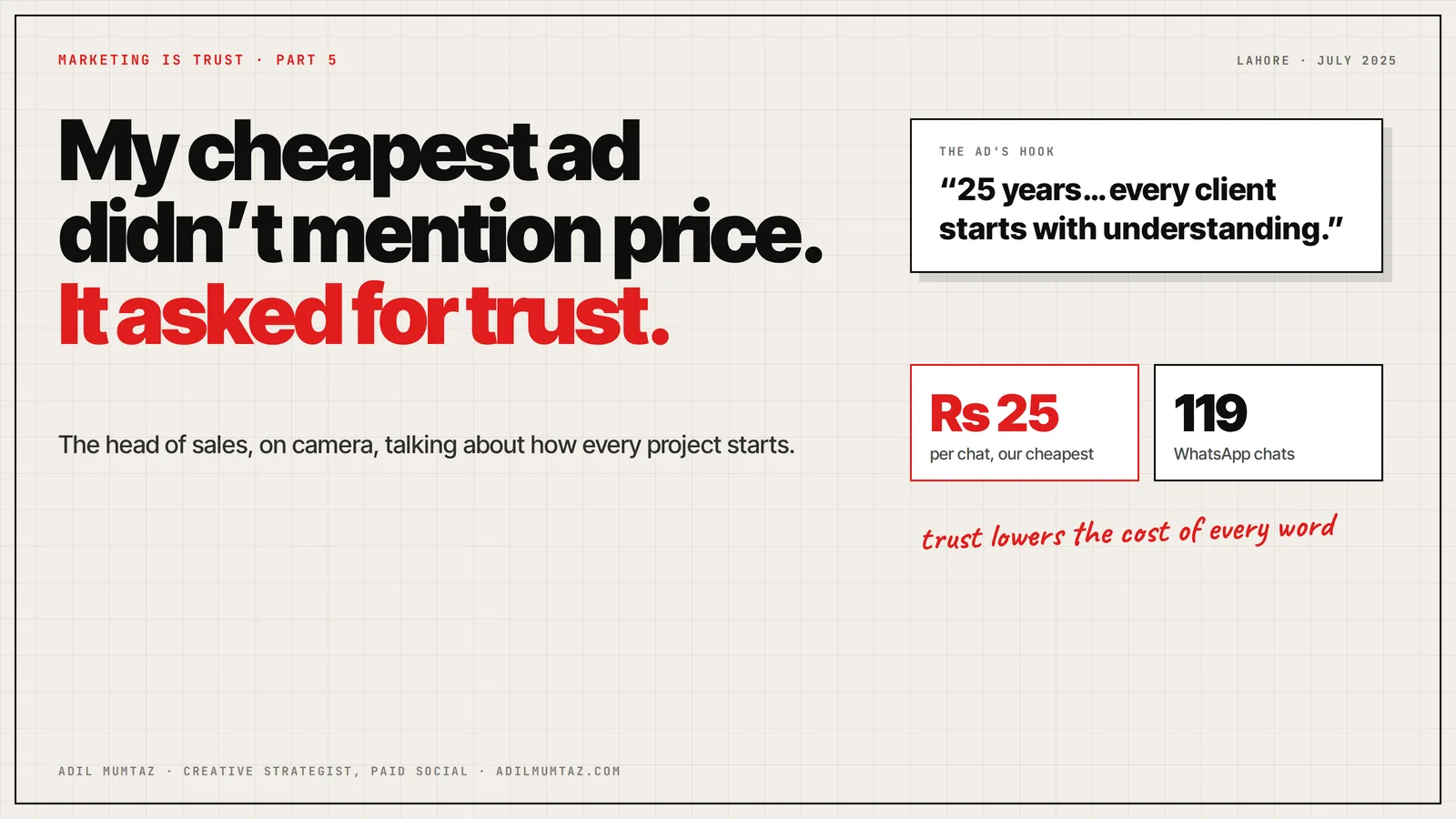
By the end of July we had tried a lot of angles. The cheapest one wasn’t a discount or an offer. It was the firm’s head of sales, on camera, talking about how every project starts.
25 years… every client starts with understanding.
The ad’s hook
Compare that with the price video from Part 3: Rs 35 a chat, and 3 serious buyers out of 112. The trust ad was cheaper per chat and brought nearly four times as many serious buyers.
Why trust is cheap
Every ad asks for something. A trust ad asks for less, so more of the right people say yes.
A person beats a promise. “We deliver quality” is a claim anyone can make. A real person explaining how they work is evidence. The buyer can judge the face, the voice and the patience.
Proof you already have beats proof you invent. Tameer didn’t need a slogan. It had 25 years. The car detailing studio I worked with in Ontario had a 4.9-star rating from 60 Google reviews. Most businesses are sitting on trust they never put in their ads.
Honesty is a hook. For that studio, the ad that worked best told people: “Send a photo and we’ll tell you honestly what your car needs.” It brought 41 chats at $2.27. The word “honestly” promised something every car owner has been denied by someone.
Trust lowers the cost of every other word in the ad.
Never promise what the business doesn’t do
Trust is slow to build and fast to lose. With the detailing studio, I checked every word of every ad against the studio’s own website before it ran. If the studio didn’t offer it, the ad didn’t say it.
That sounds obvious. It isn’t common. An ad that over-promises can win a cheap chat, and then the business loses the customer at the counter. The ad looked good. The business paid for it.
What trust doesn’t do
Trust ads are slower to show results than offers. They work best when the buyer is making a big, risky decision: a house, a car repair, a medical consultation. For a Rs 500 burger, an offer will usually beat a speech.
And trust doesn’t replace a qualifying question. Even the trust ad’s chats included browsers. The sales team still had to sort them.
Before I write the next ad, I ask
- What does this business already have that proves it can be trusted?
- Who in the business can say it on camera?
- Is there anything in this ad the business doesn’t actually do?
Part 6 is about listening: the four notes from a client that cut my cost per chat by 60%.
What proof is your business sitting on?
Tell me what your business has done. I’ll show you where the trust is hiding, and how I’d put it in the ad.
Questions people ask
How do you build trust in Meta ads?
Show a real person from the business, use proof the business already has (years of work, ratings, reviews), and promise only what it actually does. For big decisions, an honest, low-pressure ask often beats an offer.
Do staff videos work better than offers?
For big, risky purchases they can. At Tameer, a head-of-sales video was the cheapest ad at Rs 25 a chat and brought 11 serious buyers from 119 chats. For a cheap, impulsive purchase, an offer usually wins.
Why does over-promising hurt ads?
It can win a cheap chat and then lose the customer when the business can’t deliver what the ad said. Check every claim in an ad against what the business really offers before it runs.
I’m Adil Mumtaz, a creative strategist for paid social. I find the question under the ad, then I make the ad. My case studies, with the real ads and numbers, are here.