 Marketing Is Storytelling · Part 3 of 8
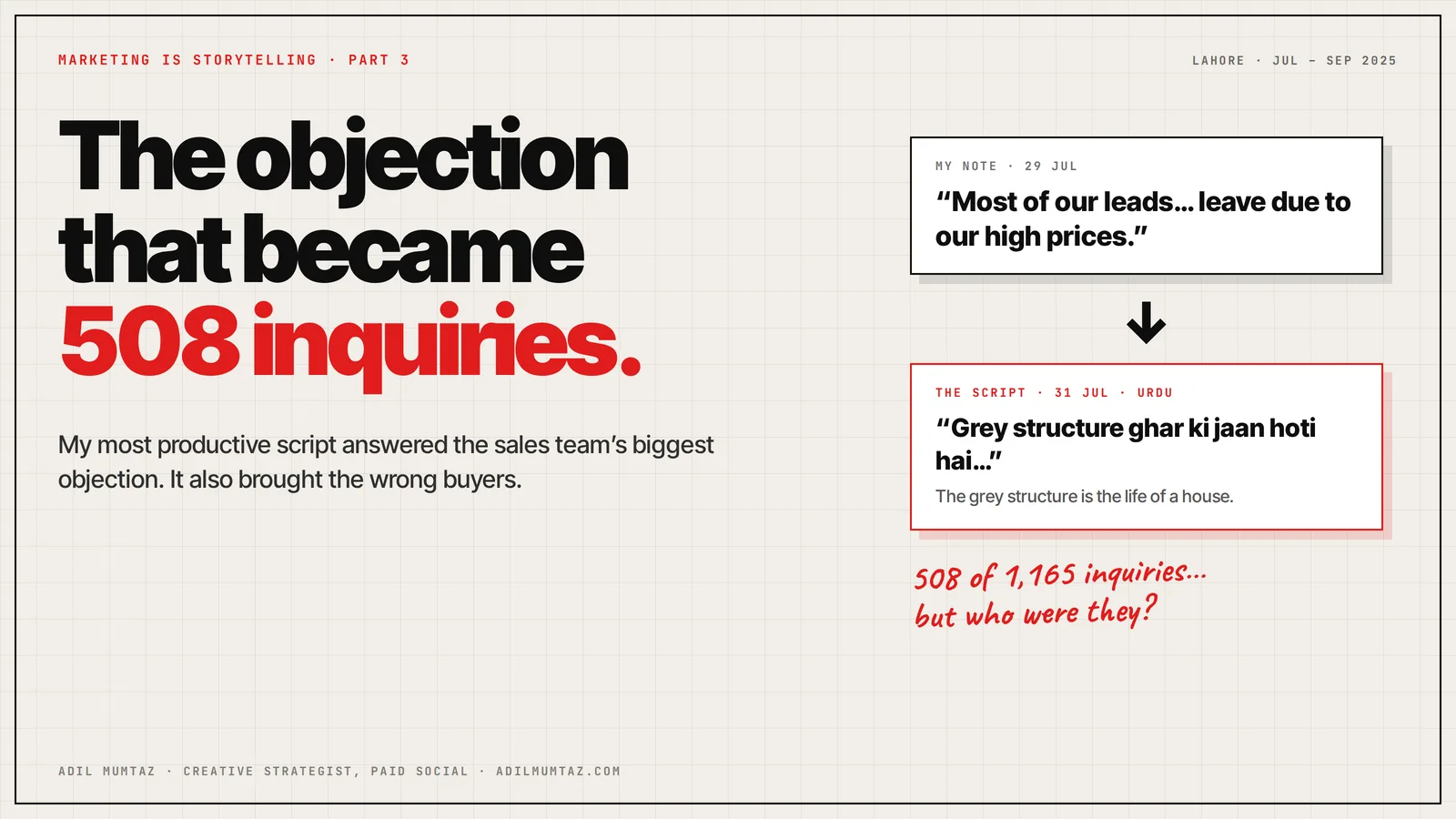
By the end of July 2025, Tameer’s ads were working. WhatsApp chats were coming in every day. Then the sales team started losing them at the same point: the price.
“Most of our leads… leave due to our high prices.” My note, 29 July 2025.
Low-standard companies and local contractors were quoting lower rates to win the job. Our buyers came to us with those quotes in hand, and many of them left with them.
Two ways to answer a price objection
You can lower the price, or you can change what the buyer is comparing.
Tameer wasn’t going to compete on rate, and it shouldn’t have: quality was the whole point of the firm. So the ads had to do the second thing.
My first answer was a headline: “Low construction rates sound attractive, till they cost you everything.” It said the buyer’s own thought out loud, then turned it.
The script
Two days after that note, I wrote the longer answer as a short Q&A. I wrote it in Urdu, because that’s the language our buyers think about money in.
The questions were the ones sales kept hearing. Some clients come to us with low rates from the market: are our grey-structure prices really higher? Can’t we win projects with low rates too? Should we just let those clients go?
The answers did the work:
Grey structure ghar ki jaan hoti hai, or usme bachaye howe 10–15 lakh apke ghar ki finishes pe lagne waale croron rupay duba sakte hain.
Insaan puri zindagi ki jama punji se aik hi baar ghar banata hai.
It closed with Tameer’s advice: build your home with an institutional-grade company.
Why it worked as a story
It changed the unit. A competitor’s quote compares rates per square foot. The script compares 10–15 lakh against crores of finishes, and against a lifetime’s savings. On those terms, nobody wins by choosing cheap.
It used a picture, not a claim. “The life of the house” is hard to argue with. “Our quality is better” is easy to ignore.
It respected the buyer. The question “should we let them go?” got a clear answer: no, guide them. The script never made the buyer feel foolish for asking about price.
What happened
In volume, the price story was the strongest idea we had. It ran from July to September and brought more than two in every five of our inquiries.
But in Part 2 I showed the other side. One price video brought 112 chats at Rs 35 each, and the sales team found 3 serious buyers among them.
What the sales sheet showed
In July, the sales team and I rated every chat by ad. Here is what four scripts brought:
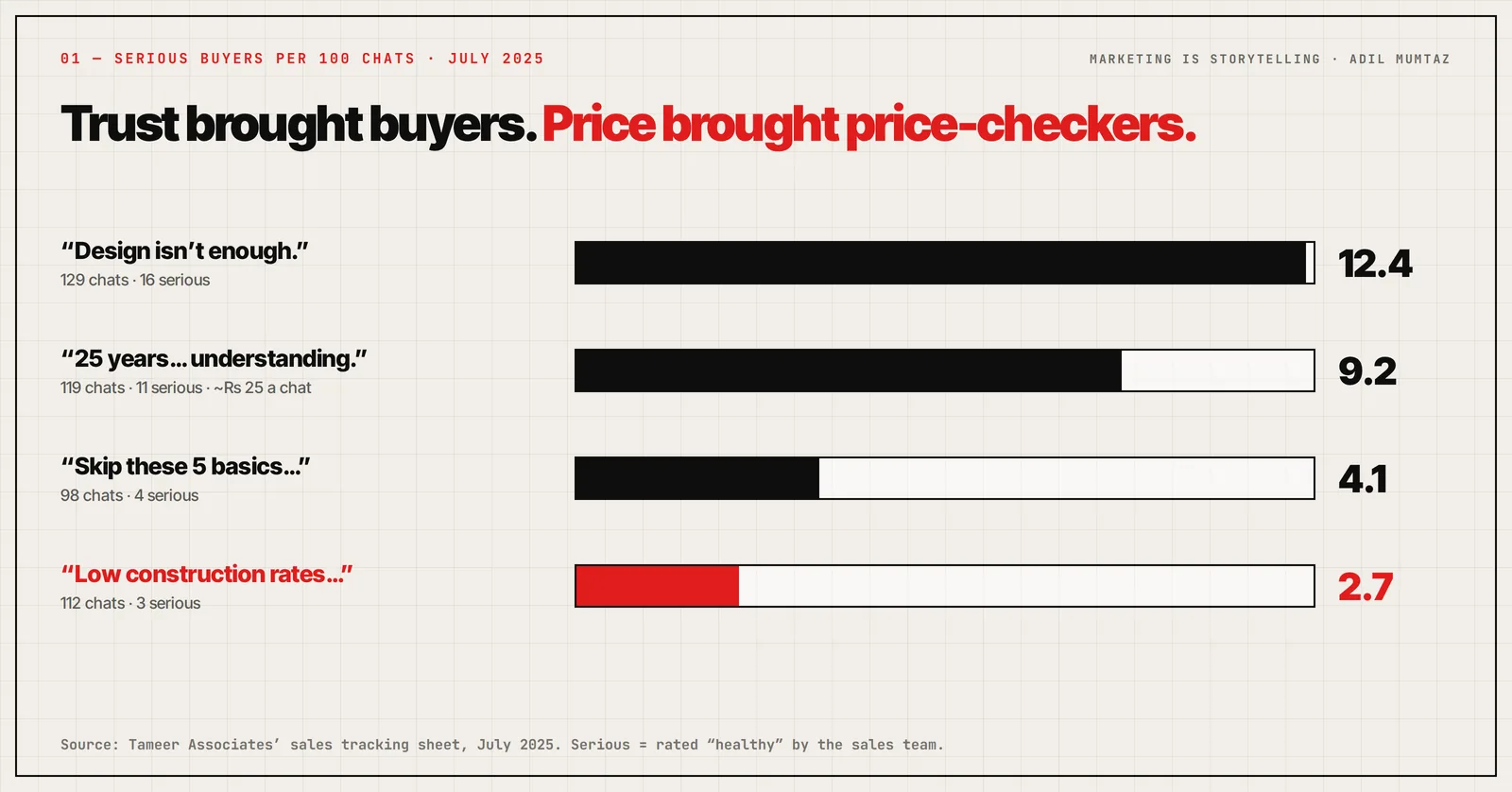
- “Design isn’t enough. Execution makes the dream real.” 129 chats, 16 serious.
- “25 years… every client starts with understanding.” 119 chats, 11 serious, at about Rs 25 a chat.
- “Skip these 5 basics…” 98 chats, 4 serious.
- “Low construction rates…” 112 chats, 3 serious.
The scripts that sold trust and execution brought three to four and a half times as many serious buyers per chat as the script that argued price.
The price story wasn’t wrong. It was in the wrong place.
What I’d write differently
Keep the objection out of the hook. The hook decides who stops. “Low construction rates” stopped the people holding a low quote. Next time I’d open with what the right buyer fears: a structure that can’t carry the home they’re dreaming of.
Answer price after trust, not before. The Q&A is a strong second step: a reply in the chat, or a follow-up video for people who have already asked. As a cold ad, it invites the very comparison it argues against.
Show, don’t argue. Footage of a grey structure going up proves what the script can only claim.
Put a small filter in the ask. Plot size and area in the first message sort the planners from the price-checkers.
Answer an objection inside the story. Put it in the headline, and you attract it.
Part 4 is about systems: three videos launched at once, a test log, and the four questions I now put in every first WhatsApp reply.
What objection does your sales team hear most?
Send it to me. I’ll show you where it belongs in your ads, and where it doesn’t.
Questions people ask
How do you handle a price objection in ads?
Change what the buyer is comparing instead of arguing about the price. Here, the script compared 10–15 lakh saved on a house’s structure with the crores spent on its finishes. Use that story after trust is built, in the chat or a follow-up video, rather than in the cold ad.
Should ads mention low prices or competitors’ rates?
Be careful. The hook decides who stops. An ad that opens with “low construction rates” stops the people holding a low quote. In Tameer’s data, that script brought 3 serious buyers from 112 chats, while trust-led scripts brought 11 to 16 from similar volumes.
How do you turn sales objections into ad scripts?
Collect the exact words buyers use with the sales team, write the questions in their language, and answer with a picture they can’t argue with rather than a claim. Then rate every script by serious buyers with the sales team, not by cost per chat.
I’m Adil Mumtaz, a creative strategist for paid social. I find the question under the ad, then I make the ad. My case studies, with the real ads and numbers, are here.