 Marketing Is Perspective · Part 1
- The problem: the ads only reached DHA, where people already had homes, and asked buyers to fill in a lead form for the biggest purchase of their lives.
- The fix: show the ads to all of Lahore, where families planning to build in DHA lived, open a WhatsApp chat instead of a form, then write the ads for that person.
- The result: from 3 leads at Rs 716 each in May 2025 to 1,165 WhatsApp inquiries at about Rs 51 each by the end of September. Spend grew from Rs 2,149 to Rs 59,204 because it paid.
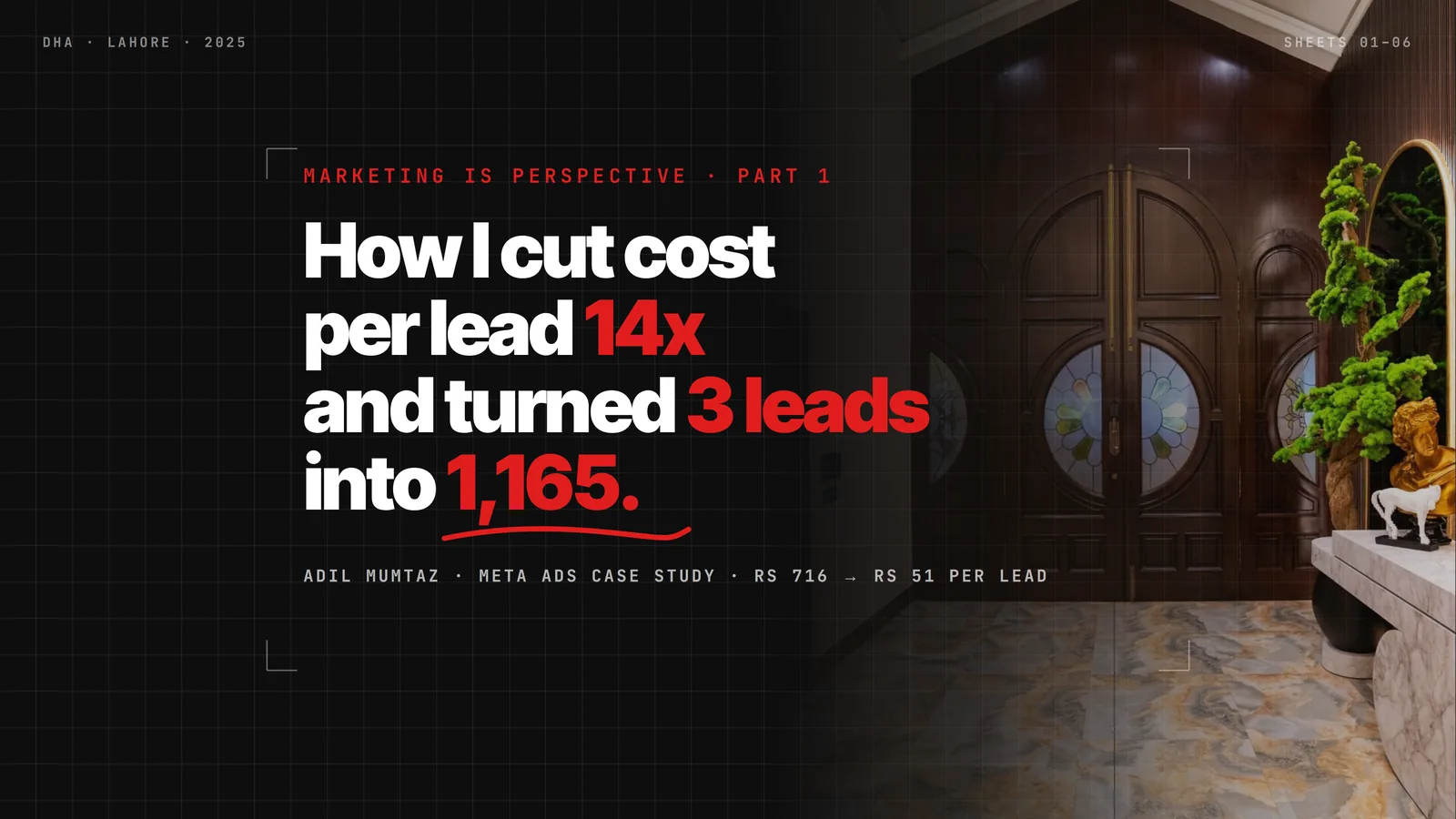
On 18 June 2025, I wrote one line in my notes: "Sales department is sitting idle… straight no leads at all."
I had just joined Tameer Associates as their digital marketing manager. Tameer is an architecture-led developer of luxury homes in Lahore, and all of its work is in DHA. They build the kind of house a family builds once and lives in for the rest of their lives.
And nobody was calling.
For a business like that, leads aren't a nice-to-have. No leads means no new homes to build. We needed leads to survive.
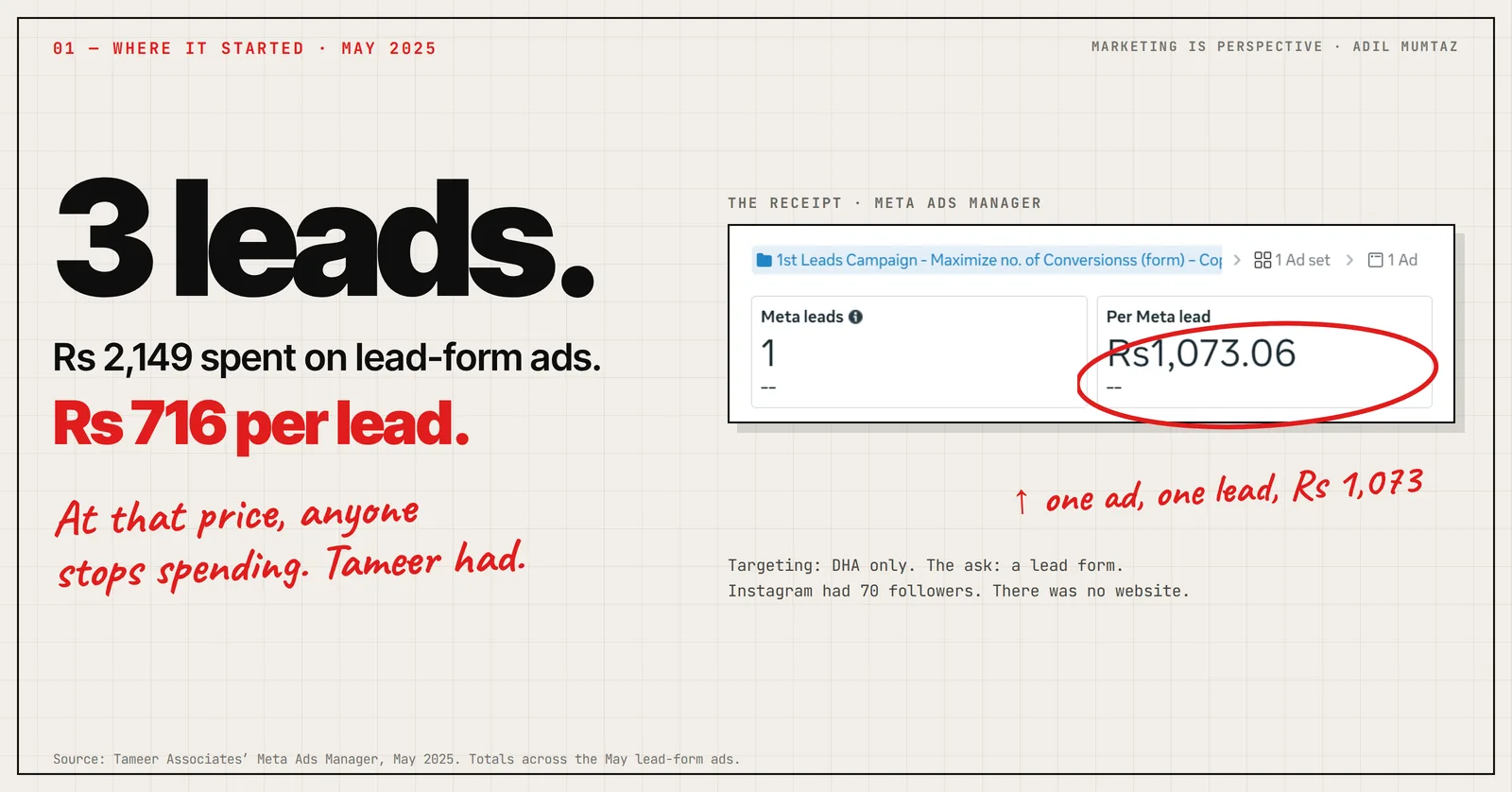
The campaign from May had spent Rs 2,149 and brought in 3 leads. That's Rs 716 per lead, and one ad had paid Rs 1,073 for a single lead. At that price, any business stops spending. Tameer had.
"Show me the ads"
My first question was the obvious one: why aren't the leads coming? So I asked to see the ads.
On paper, the campaign was perfect. Tameer builds in DHA, so the ads were shown in DHA. A lead form collected names and numbers, and sales would call them back. The ads looked fine. Every box was ticked.
That's what made it tricky. When everything looks right, the usual move is to fix the ad: a new design, sharper copy, a discount, more budget. The ad is the part everyone can see, so the ad is what everyone blames.
I left the ad alone, because I didn't know yet whether the ad was the problem.
Mark Ritson, the marketing professor behind the Mini MBA, puts the order in six words: "Diagnosis informs strategy, strategy directs tactics." He calls the habit of skipping straight to execution "tactification". A new ad is execution. I needed the diagnosis first.
Through the buyer's glass
So I stopped looking at the campaign as a marketer and looked at it the way a buyer would. Two questions changed everything.
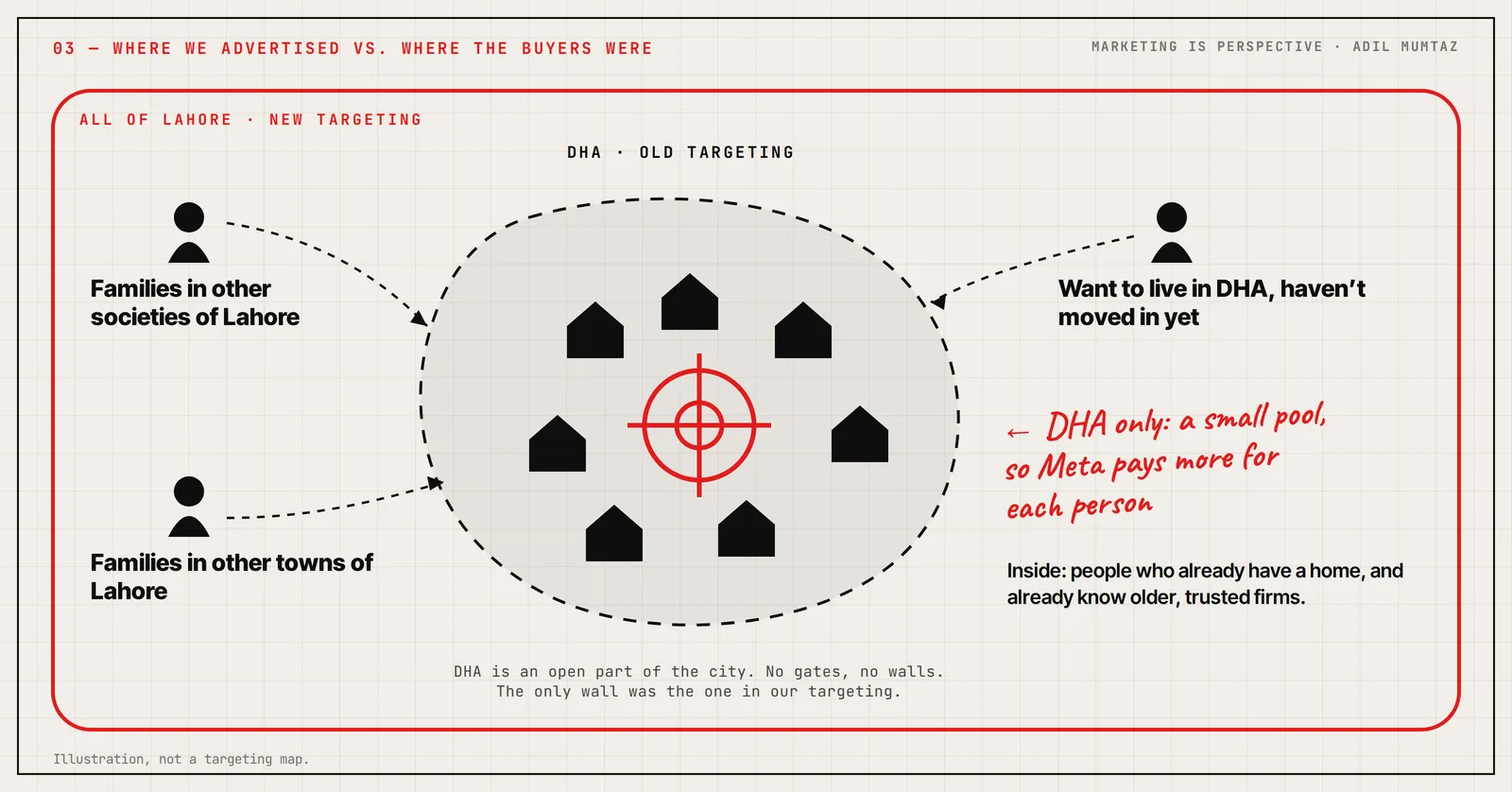
Who actually needs a new home built in DHA? Not the people already living there. They have homes. Many were there long before Tameer started working in DHA, and they already knew plenty of good, older firms. A location on a map can't tell you who is about to build. An address isn't an intention.
The people who need Tameer are families in other parts of Lahore who want to live in DHA and haven't built yet. Our ads never reached them. And because the audience was one small area, Meta had very few people to choose from, so every person cost more.
Our ads were talking to people who were already home.
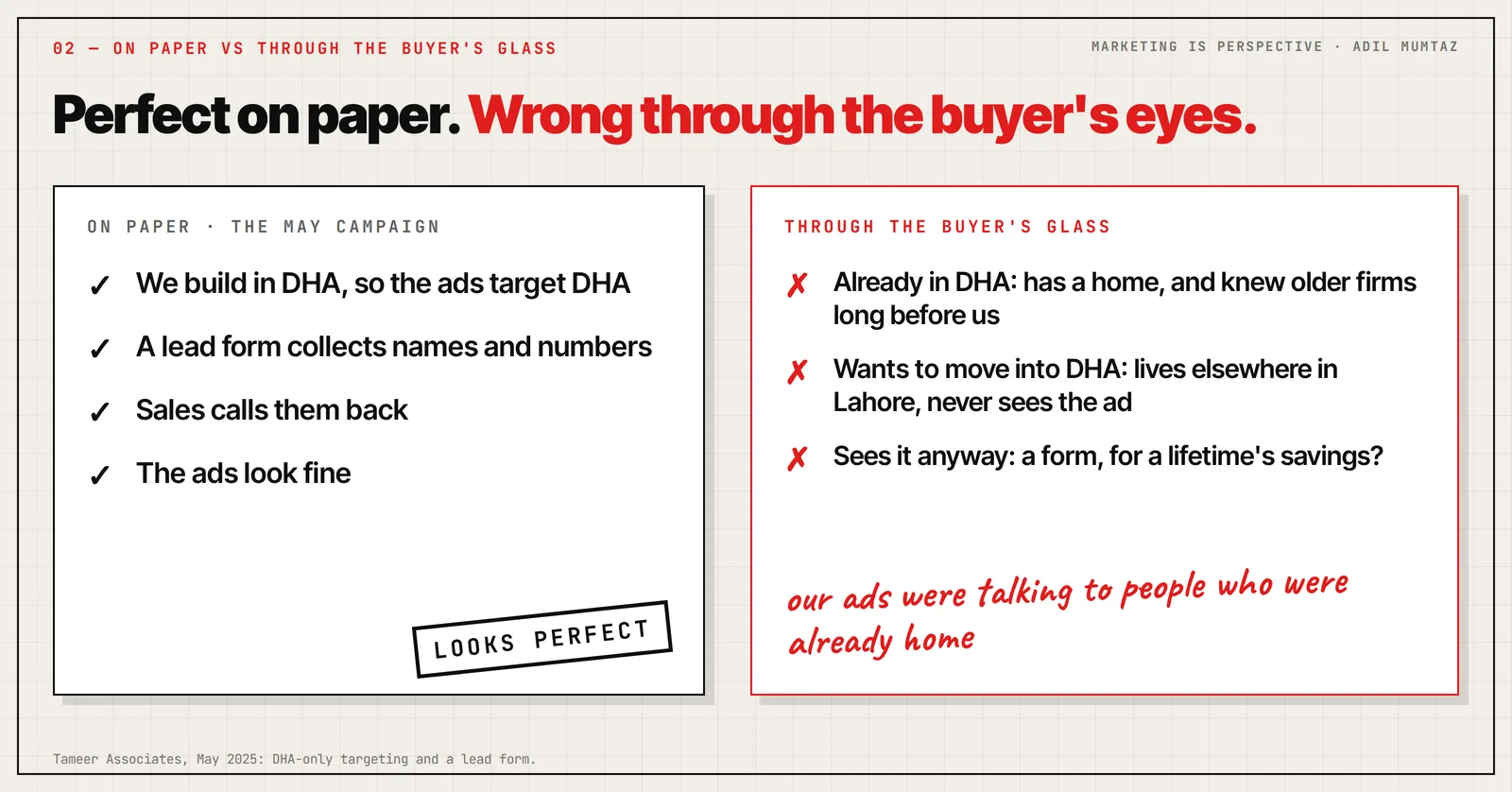
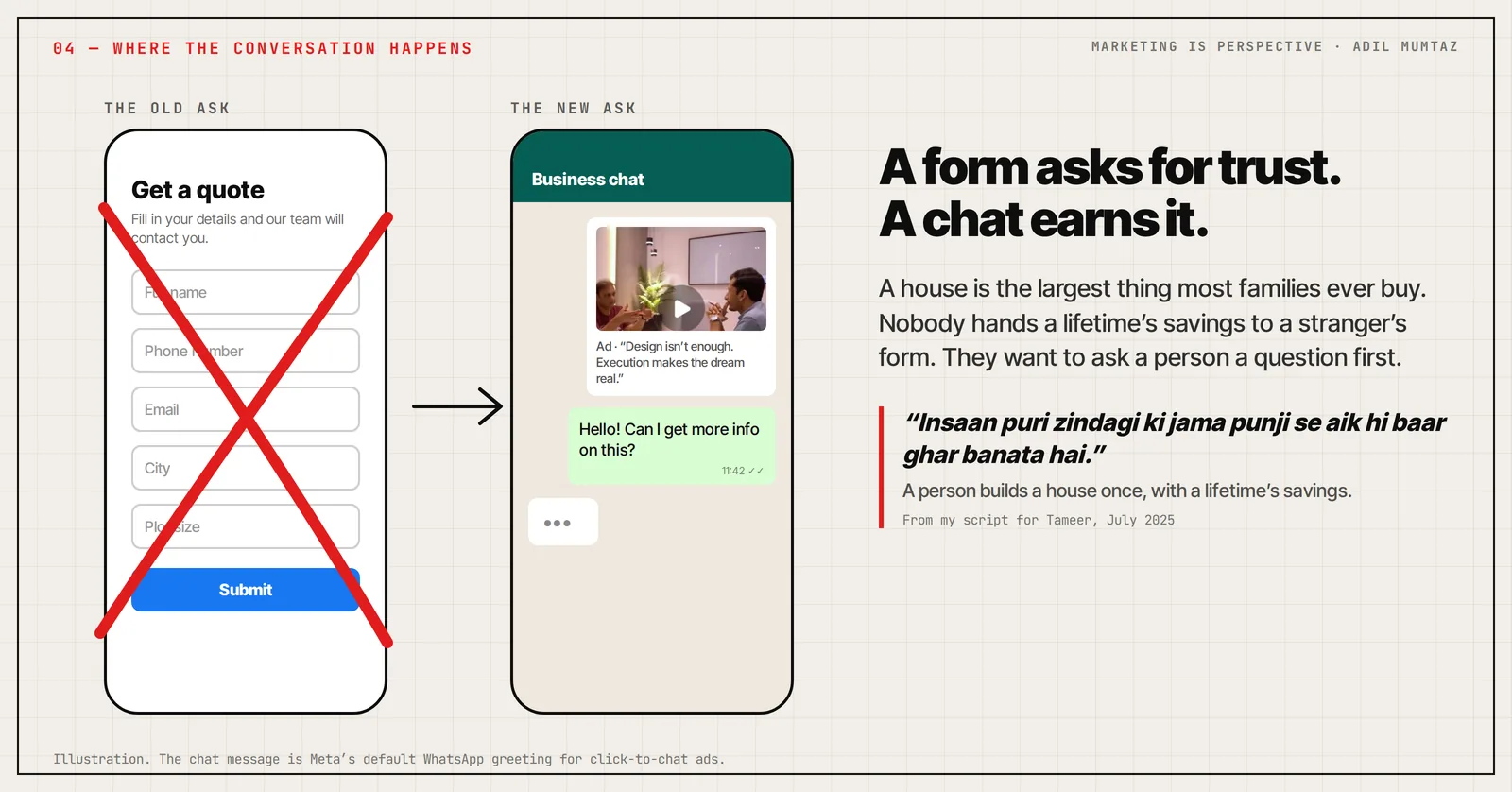
And if the right person did see an ad, how would they reach us? Through a form: name, number, submit, then wait for a call from a stranger. That works for a free download. It doesn't work for a house. In a script I wrote for Tameer that July, I put it in Urdu: "Insaan puri zindagi ki jama punji se aik hi baar ghar banata hai." A person builds a house once, with a lifetime's savings.
Nobody hands a lifetime's savings to a form. People want to ask a question first. In Pakistan, they ask it on WhatsApp.
So the problem wasn't the ad. It was the thinking under it: the wrong location, and the wrong way to start a conversation.
"Why should we advertise outside DHA?"
I proposed two changes before touching a single ad: open the targeting from DHA to all of Lahore, and replace the form with a WhatsApp chat.
That's when my team lead stopped me. "We only do business in DHA. Why should we advertise to the rest of Lahore?"
It was a fair question. On paper, he was right. If you do business in DHA, you advertise in DHA. That's the theory, and most people would sign off on it.
I gave him my reason. The people already in DHA have their homes and their trusted names, and as the newer firm there, we'd have to win them away from someone. The people still on their way into DHA haven't chosen anyone yet. Those are the people we can onboard.
Then I said: trust me.
I had reason to be confident. At my own agency, ads that opened WhatsApp for Munch, a fast-food restaurant in Kohat, had brought 159 conversations at about Rs 45 each. Different product, same habit. People here would rather send a message than fill in a box.
The first three days
The first ad of the new setup went live on 1 July, less than two weeks after that note about the idle sales team. Its line was written for someone holding a plot and a plan, deciding who to trust with both: "Design isn't enough. Execution makes the dream real."
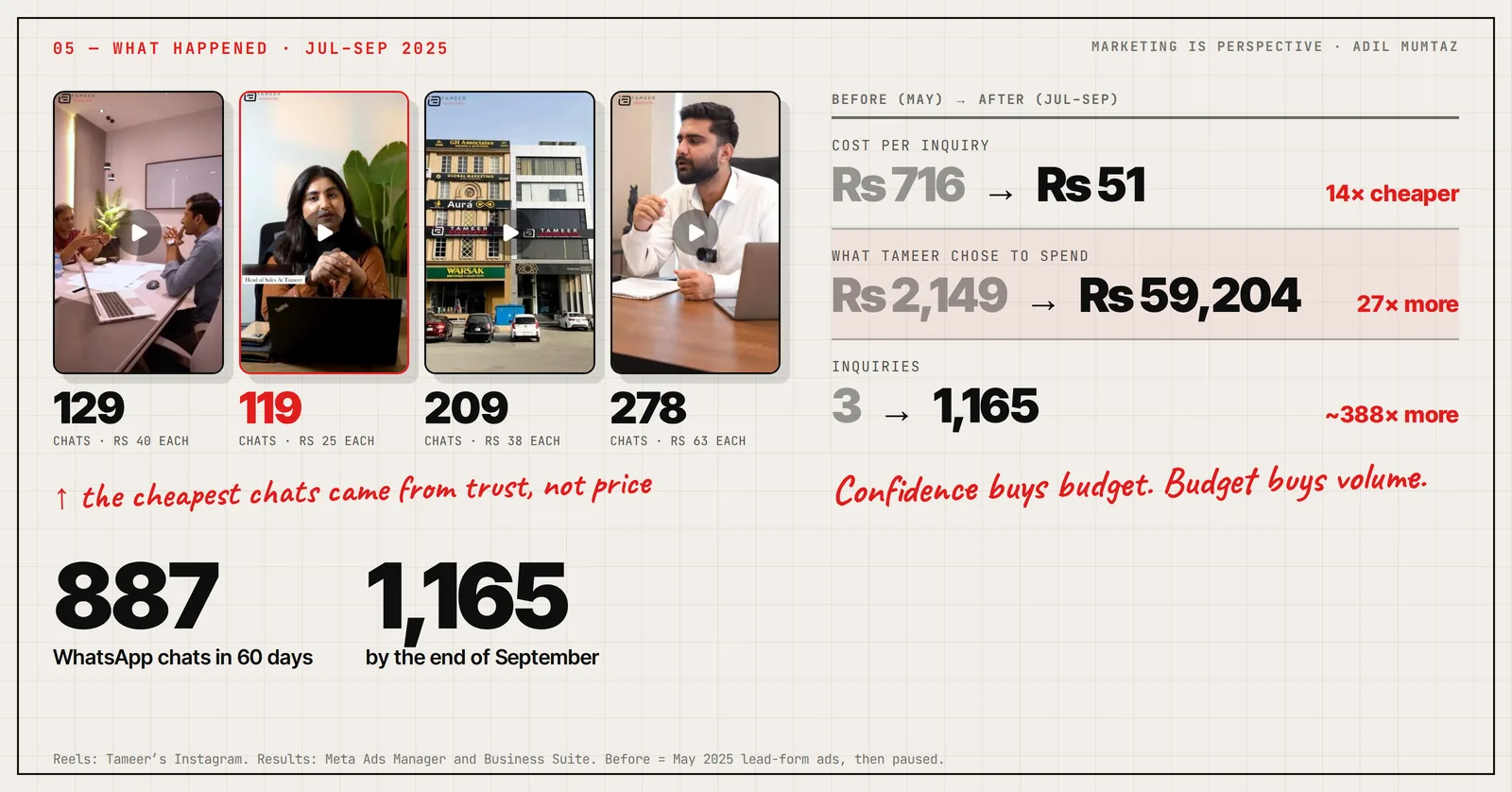
In three days, it started 129 WhatsApp chats, at about Rs 40 each.
The new ad wasn't a prettier version of the old one. It was written for a different person.
What happened next
In the first 60 days, the ads brought in 887 chats. By the end of September, 1,165, at an average of about Rs 51 each. That's roughly 14 times cheaper per inquiry.
The number I care about most, though, is spend. At Rs 716 a lead, Tameer stopped after Rs 2,149. At about Rs 51 a chat, they kept going for three months and spent Rs 59,204, about 27 times more. I didn't have to talk anyone into it. The numbers did.
That's how 3 leads became 1,165.
Something else changed too. Nobody made a speech about it, but the satisfaction showed, and from then on my suggestions were agreed to more often. That trust is what let the ads keep getting better. The cheapest ad of all turned out to be about trust, not price: "25 years… every client starts with understanding," at about Rs 25 a chat.
What it didn't fix
A chat isn't a sale. The sales team rated 7% to 11% of chats as serious buyers. Our "low construction rates" videos also pulled in price-shoppers: one of them brought 112 chats at Rs 35.53, and sales found 3 serious buyers among them. Costs crept up too, from about Rs 43 a chat in July to about Rs 63 in September. If I ran it again, I'd qualify people in the first reply.
Still, a sales team that had nobody to call in June had hundreds of people to talk to by September.
Why I call it perspective
From the inside, that campaign looked perfect. I only saw the flaw because I looked at it through the buyer's glass.
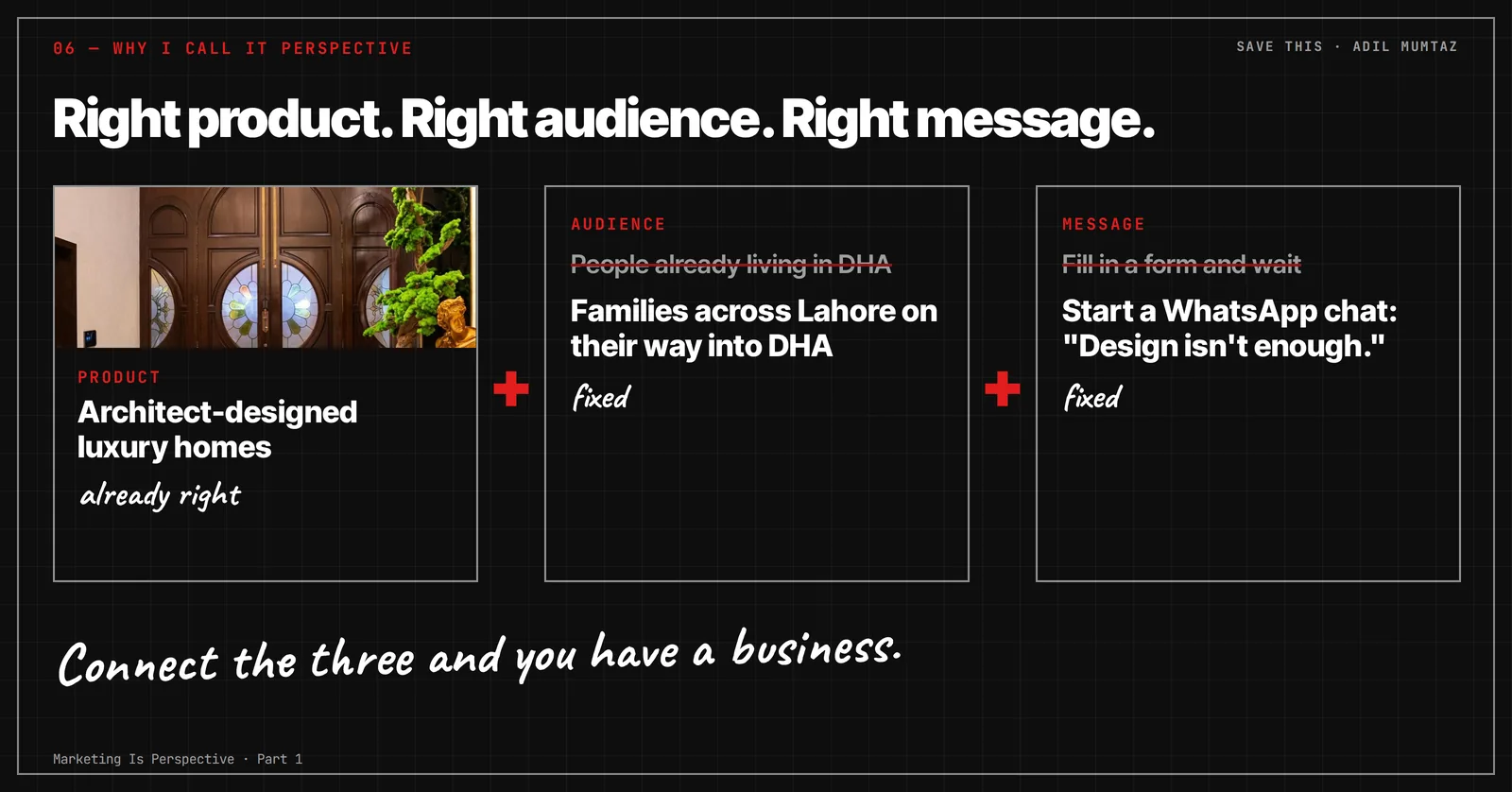
That's what perspective gives you. It tells you three things: the right product, the right audience and the right message. Connect the three and you have a business.
Tameer always had the right product. What we had wrong was the audience, and the way we asked them to talk to us. Where you build isn't always where your buyers are.
That's why I'm calling this series Marketing Is Perspective. Part 2 is about psychology: why my cheapest leads were my worst.
Has a campaign of yours ever looked perfect on paper?
If it's running right now and the leads aren't coming, send it to me. I'll look at it through the buyer's glass and tell you what I'd change first.
Questions people ask
Why are my Meta ads not getting leads?
Often the ad isn't the problem. Check two things first: who the ads reach, and what they ask people to do. Ads shown to people who already have what you sell won't find buyers, and a lead form is a big ask for a big purchase. Fixing those two, then writing ads for the right person, cut Tameer's cost per inquiry about 14 times.
Are click-to-WhatsApp ads better than lead forms?
For big, high-trust purchases in markets where people already message businesses on WhatsApp, a chat often works better, because buyers can ask a question before handing over their details. Here, WhatsApp chats cost about Rs 51 against Rs 716 per form lead. But a chat isn't a sale: the sales team rated 7–11% of chats as serious buyers, so qualify people in the first reply.
Does targeting a small area make Meta ads more expensive?
It can. A small audience gives Meta fewer people to choose from, so each result tends to cost more. In this case the bigger issue was that the small area was the wrong one: the buyers lived outside it.
I'm Adil Mumtaz, a creative strategist for paid social. I find the question under the ad, then I make the ad. My case studies, with the real ads and numbers, are here.