 Marketing Is Subtraction · Part 7 of 8
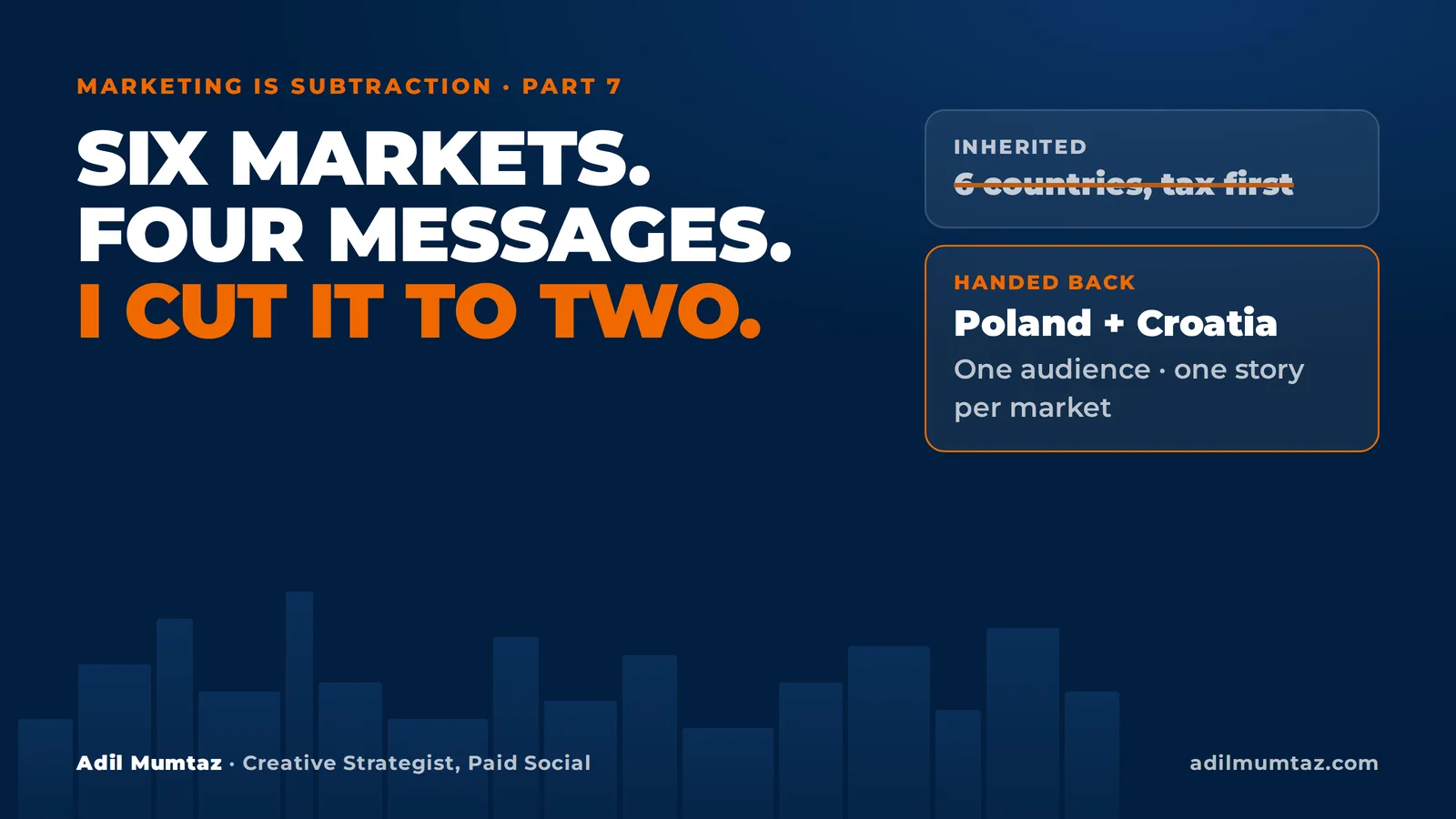
In June 2026 a UAE business-setup consultancy and its partner wanted clients from Europe. A plan was drafted while I was ill. When I came back, the partner had given feedback, and the plan became mine to fix.
It wasn’t short of ideas. It had too many.
What the plan was trying to do
It spread a pilot budget of AED 5,000–7,000 a month, ad spend and management together, across six countries. It led with tax. And it offered four different messages at once, from protecting wealth to investing abroad to moving the family.
On paper, it covered everything. In practice, it would have learned nothing.
The arithmetic of too much
I had just run the same consultancy’s campaign for US business owners. Conversations there cost AED 40 to 49 each, on every audience I tried.
If European conversations cost anything like that, a few thousand dirhams split six ways buys around a dozen conversations per country per month. That’s not a test. That’s noise with a budget.
A budget split six ways doesn’t test six markets. It fails to test all of them.
What I took out
Four countries. I kept Poland and Croatia, for different reasons. Poland is the larger, more scalable business market. Croatia is smaller and more relationship-driven, which suits a premium, trust-led story.
Most of the audience. Instead of “European business owners”, one group: cross-border commerce operators. Traders, importers and exporters, online sellers. People whose business already crosses borders and who would see a UAE base as a tool, not an escape.
The tax hook. The UAE’s tax rules are real, but tax residency isn’t automatic, and an ad that leads with “stop paying tax” attracts the wrong people and invites trouble. The plan I handed back led with something sturdier.
Tax became a supporting point, not the headline.
Three of the four messages. One story per market, told differently for each: scale and trade routes for Poland, trust and premium service for Croatia.
What stayed
The production plan stayed ambitious where it mattered. Scripts were written in English, to be translated and shot with native speakers in Dubai, so a Polish business owner would hear Polish. The launch was set for 1 August.
The client accepted the plan. I can’t show you results: this one is a plan, not a campaign report, and I’d rather say so than dress it up.
Why subtraction is a marketing skill
It’s easy to add. Every stakeholder has one more country, one more audience, one more benefit. Each addition sounds reasonable. Together they make a campaign that can’t learn.
Michael Porter put it in one line: “The essence of strategy is choosing what not to do.” In paid social that has a price tag. Every extra market, audience or message divides the budget that’s meant to teach you something.
Before I approve a plan, I ask
- Can this budget teach us something in each market, in four weeks?
- Who exactly is the first audience, in one sentence?
- What’s the one story, and what are we leaving out to tell it?
Part 8, the last in the series, is about local marketing: a restaurant video that reached 161,956 people and started zero conversations.
Is your plan trying to do too much?
Send it to me. I’ll tell you what I’d take out first, and why.
Questions people ask
How many countries should a pilot ad campaign target?
As few as the budget can actually test. If conversations cost around AED 40–49, a few thousand dirhams split six ways buys about a dozen per country a month, too few to learn. Two markets with a clear audience can teach you something.
Should UAE business setup ads lead with tax?
It’s risky. Tax residency in the UAE isn’t automatic, and a “stop paying tax” hook attracts the wrong people. Leading with a compliant business base, banking readiness and residency planning is sturdier; tax works as a supporting point.
How do you narrow a marketing plan?
Ask whether the budget can teach you something in each market, name the first audience in one sentence, and choose one story per market. Everything else waits.
I’m Adil Mumtaz, a creative strategist for paid social. I find the question under the ad, then I make the ad. My case studies, with the real ads and numbers, are here.