 Marketing Is Systems · Part 4 of 8
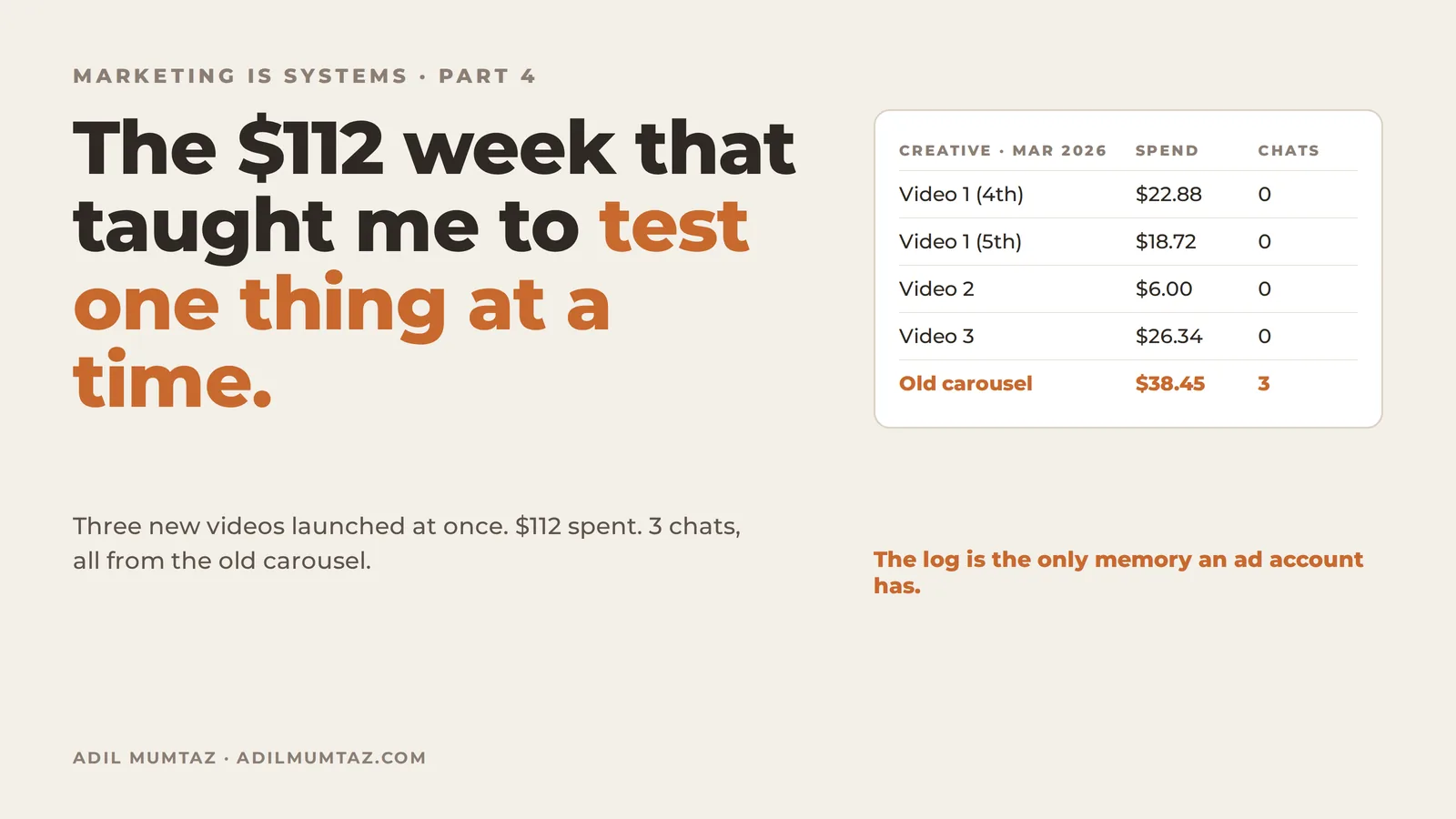
In March 2026 the blinds account had just moved to WhatsApp, and I had three new videos ready. I was excited about all of them. So I launched them all at once, next to the carousel that was already working.
A week later the account had spent $112 and brought 3 chats.
All 3 came from the old carousel. The three videos had spent $74 between them and started nothing.
What that week actually tested
Nothing. That’s the honest answer.
The budget was small, and I had split it four ways. One video got $6 and was shown to 170 people. Another got $19. None of them had enough delivery to tell me anything. I couldn’t say whether the videos were bad, or simply unseen.
One of those creatives later ran on its own and brought 41 chats. They were the cheap, wrong chats from Part 2, but the point stands: the launch hadn’t measured the creative at all. It had only measured my impatience.
The system I built after
A creative idea is a guess. You need a system to find out which guesses were right. Mine has five parts now, and each one came from a mistake.
1. One change at a time
I relaunched the carousel on its own: 30 chats on $413. From then on, every new test changed one thing: the image, the hook or the ask. Never all three. When I later wrote golden-visa ads for a UAE consultancy, the rule went into the brief itself: one variable per ad.
2. A test log
Every creative gets a row the day it launches: the date, the format, impressions, spend, click rate, link clicks, 3-second views, ThruPlays, chats and calls. It takes two minutes. It’s the only memory an ad account has.
3. Read the signal that matches the goal
Click rate tells you who’s curious. Chats tell you who wants to talk. For the car detailer, the ad with the higher click rate brought 4 chats; the lower one brought 41. I now judge a WhatsApp ad on the share of clicks that become chats.
4. Qualify in the first reply
For the blinds client, 30–40% of the early chats were spam. So the first WhatsApp reply now asks four things:
- Which city are you in?
- How many windows?
- What type of blinds?
- Is it for a home or an office?
A real buyer answers in a minute. A browser doesn’t answer at all. Either way, sales knows where to spend its time.
5. Data before scaling
Before I ask for more budget, I ask the client for four numbers: bookings, quotes, closed jobs and job value. Chats are my number. Sales are theirs. Scaling on mine alone is how you scale the wrong ad.
What the system did
In April the carousel ran alone, and every change to it was logged. It brought 62 chats at $14.01. Across the account: 161 WhatsApp chats and 12 calls, at $11.77 per inquiry.
That’s not a dramatic number. It’s a reliable one. And reliable is what lets a client keep spending.
Creativity finds the ideas. A system tells you which ones to keep.
What it doesn’t fix
A system can’t make a weak idea strong. It only stops you from fooling yourself about which ideas are weak. You still need the perspective, the psychology and the story from Parts 1 to 3. The system just keeps score.
Part 5 is about trust: why my cheapest ad at Tameer didn’t mention price at all.
Do you know why your last test won?
If you’re not sure which change made the difference, send me the account. I’ll show you how I’d set up the next test so the answer is clear.
Questions people ask
How many ad creatives should I test at once on a small budget?
Fewer than you think. On a small daily budget, splitting spend across four new creatives means none gets enough delivery to tell you anything. Test one or two at a time, change one thing per test, and give each enough spend to produce real results.
What should a Meta ads test log track?
For every creative: launch date, format, impressions, spend, click rate, link clicks, 3-second views, ThruPlays, and the result you actually want, such as chats or calls. The log is how you notice that a “video” got 6 views on 9,839 impressions.
What should the first WhatsApp reply ask a lead?
Two to four quick questions a real buyer can answer in a minute. For a blinds company: which city, how many windows, what type of blinds, and whether it’s for a home or an office. Serious buyers answer; browsers drop off.
I’m Adil Mumtaz, a creative strategist for paid social. I find the question under the ad, then I make the ad. My case studies, with the real ads and numbers, are here.